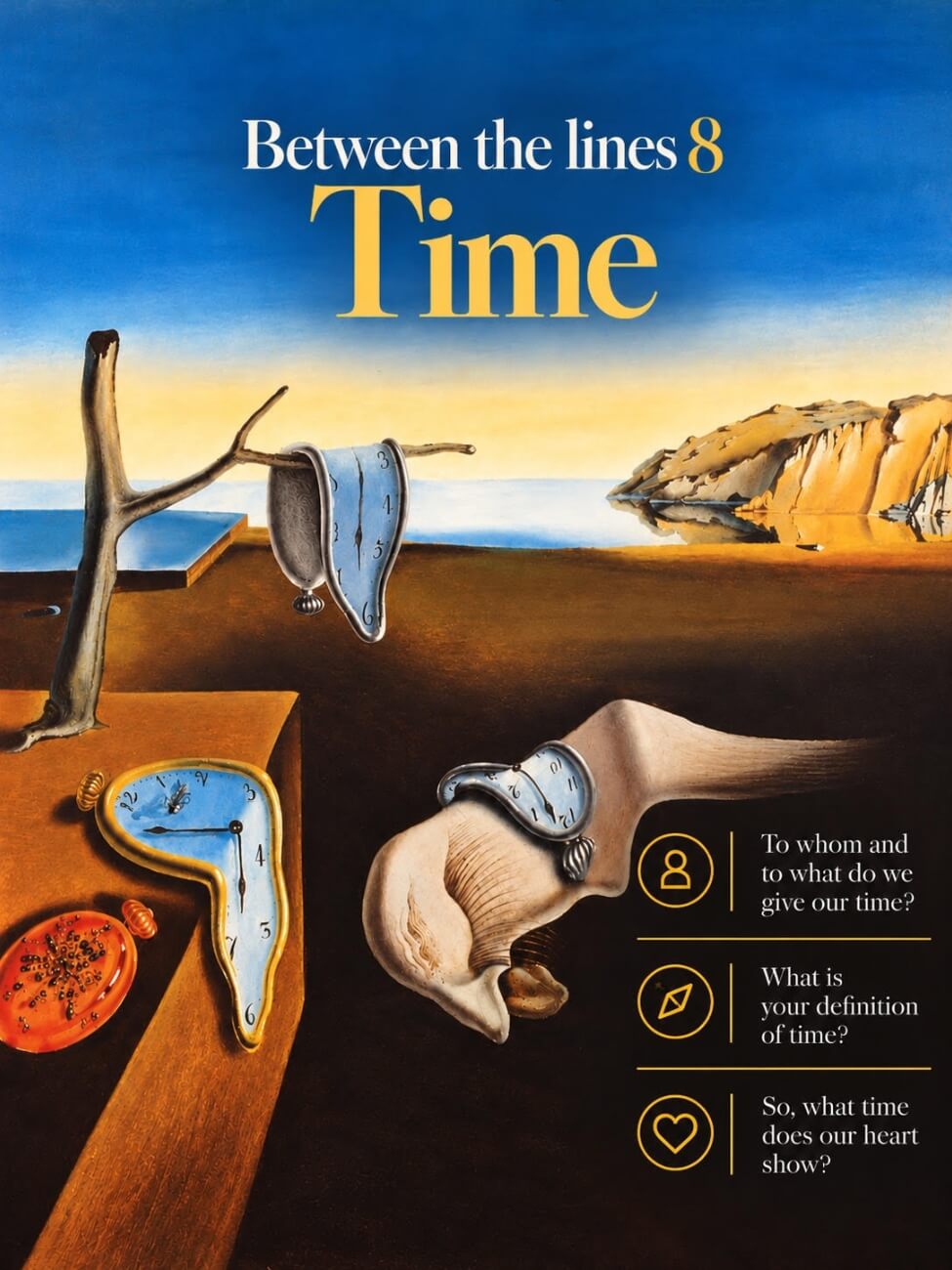
If someone asked us, “What is time?”, most of us would probably have something to say.
For some, there’s never enough of it. For others, it seems to fly by. Sometimes it feels endless; at other times, we wonder where it has gone.
We measure it with clocks, organise it with calendars and try to manage it through our plans. We remember the past, imagine the future and do our best to stay present.
But what exactly is time?
In our eighth Between the Lines gathering, we explored this question together. Our conversation took us from physics to mythology, from childhood memories to the finite nature of life, and from personal choices to moments of silence.
Along the way, we discovered just how differently we experience and understand time.
Is Clock Time the Same as the Time We Experience?
Our conversation began with different ways of defining time.
For one of us, time was the accumulation of experiences throughout life. For another, it was life itself — our lifetime. Some associated it with dreams and possibilities that lie ahead, while others saw it as a common language humanity has created to organise life and communicate with one another.
As one participant put it:
“Time is the ruler of my mind.”
A way of measuring how far we’ve come, what we’ve experienced, where we stand and where we hope to go.
Yet the time shown on a clock isn’t always the same as the time we experience.
As children, waiting for a birthday, a holiday or simply to grow up can feel endless. But as the years pass, time seems to accelerate. A year that feels as though it has only just begun is suddenly over. Children grow up, and we find ourselves reaching ages that once seemed impossibly far away.
When we’re happy, we lose track of time. When we’re bored, even a few minutes can feel like an eternity.
So, is time changing, or are we?
Chronos or Kairos?
Our conversation also brought us to two ancient Greek concepts of time: Chronos and Kairos.
Chronos represents measurable, sequential time, while Kairos refers to the right, meaningful or opportune moment.
One belongs to the world of clocks and calendars; the other invites us to consider the quality of the moment we’re experiencing.
Much of our everyday life follows the rhythm of Chronos: meetings, deadlines, commitments and never-ending to-do lists.
But amid all this, how much room do we make for Kairos — those moments that truly matter?
Sometimes a conversation, an encounter, a decision or an unexpected realisation takes up only a few minutes in our calendar, yet leaves a lasting mark on our lives.
When Do We Truly Appreciate Time?
One of the most moving parts of our gathering was listening to personal experiences that had profoundly changed how people perceived time.
An earthquake, an accident, illness, loss…
Experiences that interrupt the familiar rhythm of life can remind us just how fragile and irreversible time can feel.
One participant shared how an accident had changed the way they looked at everything they had been putting off.
Another spoke about a difficult health experience that helped them recognise the need to let go of worrying about what others might think.
For someone else, appreciating time began with accepting that certain moments can never be revisited.
And even when there’s a place we’d love to return to, or an encounter we wish we could experience again, neither we nor the people and circumstances we left behind are quite the same.
Who and What Do We Give Our Time To?
Recognising that our time is limited doesn’t necessarily make us want to do more. Sometimes, it helps us decide what notto do.
One participant described how their changing relationship with time had given them greater freedom to say “no”.
When we attend a gathering, dedicate ourselves to a task or spend time with someone, we’re not simply giving away an hour from our calendar.
We’re giving a part of our lives to that experience.
Could the way we choose to spend our time also be a reflection of what we truly value?
Can the Past Change?
As we explored time, we also considered whether the past might, in some way, remain part of our present.
Some memories stay with us for years, carrying the same emotions. Others take on entirely different meanings as we grow and change.
We recognised that while an event from the past may remain unchanged, our relationship with it can evolve.
An insight we gain today may change the meaning we attach to an earlier experience. And that new meaning may influence the choices we make tomorrow.
Seen this way, the past, present and future no longer feel like entirely separate chapters of our lives.
How Long Is a Moment?
Sometimes, forty-five seconds can feel endless.
In a film, years may pass in just a few minutes. A single page of a book might explore a few seconds in extraordinary detail, while the next takes us several years into the future.
One participant described how reading a book or watching a film allowed them to step into someone else’s life and experience of time. When the story ended, they became newly aware of their own present.
For another, time seemed to expand during moments of focused breathing in yoga.
Some of us felt time more vividly in the movement and energy of a busy city. Others encountered it in silence, in stillness, or in those rare moments when there was nowhere else we needed to be.
Through these different experiences, we noticed how our understandings of time and the present moment sometimes diverged and sometimes came together.
Isn’t Pausing Part of Living, Too?
Towards the end of our gathering, our attention shifted from time itself to the meaning of the time we were spending together.
According to our calendars, we had met at a particular hour and set aside ninety minutes.
But what made those ninety minutes meaningful wasn’t the movement of the clock.
It was listening to one another, being curious about different perspectives, allowing ourselves to be surprised and occasionally questioning what we thought we knew.
For one participant, the gathering offered a chance to pause after a busy day, without having to do anything else.
For another, the meaning was found precisely in that experience of pausing and sharing.
Pausing. Being present. Listening. Hearing. Understanding.
Perhaps these are some of the things that give our time meaning.
So, What Time Is It in Our Hearts?
At the end of our gathering, everyone was invited to redefine time in their own words.
“Time is the ruler of my mind.”
“A moment is a meaningful state of being.”
“A moment is infinite time.”
And another reflection that particularly stayed with me spoke of the heart having its own sense of time.
We can look at a clock and easily tell what time it is.
But can we tell, just as easily, where we are emotionally?
Are we still in a conversation from the past, somewhere in a future that hasn’t yet arrived, or truly present in the moment we’re living?
We didn’t arrive at a shared definition of time. Yet our conversation reminded us that time isn’t simply something we measure.
It’s also something we give meaning to, shape through our choices and fill with our experiences.