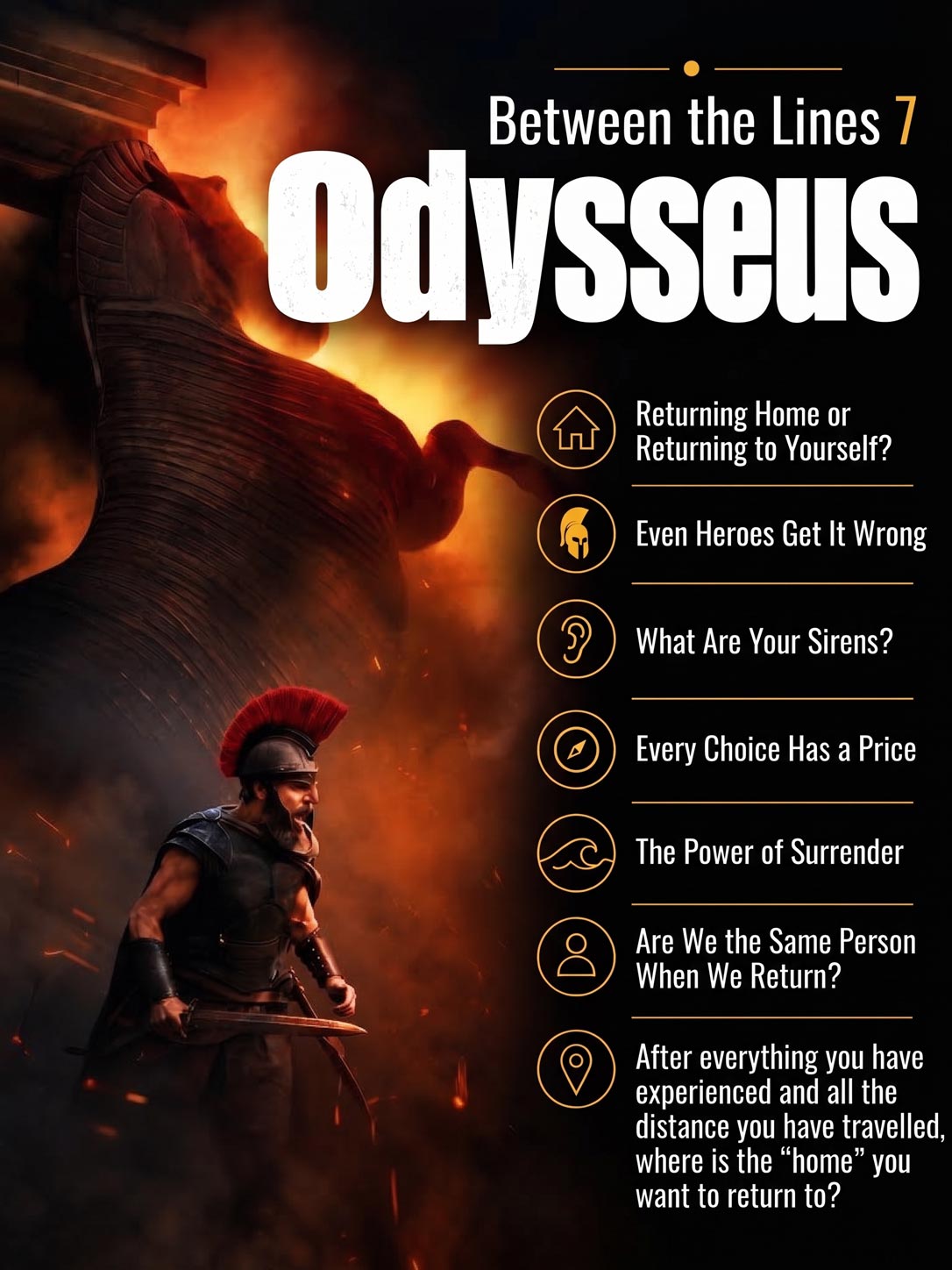
Returning Home or Returning to Yourself?
Some stories survive for centuries because, although the characters and settings change, the questions at their heart remain deeply human.
Odysseus is one of them.
A king trying to find his way home after war. A long journey filled with gods, sirens, storms, temptations, losses and difficult choices.
At our latest Between the Lines gathering, we took the film Odysseus as our starting point. As the conversation unfolded, we realised that the story was about much more than reaching Ithaca.
Perhaps the real journey was about finding the way back to oneself.
What Does It Mean to Return Home?
Odysseus spends years trying to return home. Yet while he is away, the world he left behind changes.
So does he.
His wife, his son, his country and the life he remembers are no longer quite the same.
This led us to one of the central questions of our conversation:
Where is home?
Is it a place? The people waiting for us? Or something within us that we try to rediscover after all the journeys, victories, losses and regrets?
Perhaps returning home is not simply about going back to where we started. It is about meeting home again as the person we have become along the way.
Even Heroes Get It Wrong
Those familiar with the original story noted that the film offers a more modern — and perhaps gentler — interpretation of Odysseus. Yet it still raises questions that feel surprisingly relevant today.
Odysseus is intelligent, strategic and courageous. He is a leader capable of inspiring people to follow him.
But he is also ambitious, proud, curious and sometimes dangerously convinced of his own judgement.
And his choices affect not only him, but also those who follow him.
One by one, he loses the people who began the journey with him. Eventually, he returns alone.
Perhaps this is one reason the story still resonates.
Heroes are not perfect. Neither are leaders.
Intelligence, courage and strategy can take us far. But without the willingness to see ourselves, recognise the impact of our choices and confront our own ego, something in the journey remains unfinished.
What Are Your Sirens?
One of the scenes we returned to most often was Odysseus listening to the sirens.
He wants to hear them, but he also knows the danger. So rather than escaping their voices, he asks to be tied to the mast of his ship.
But what do the sirens represent?
Do they reveal our deepest truth? Whisper something we desperately want to hear? Or simply tempt us away from our path?
Perhaps we all have our own sirens: ambition, status, curiosity, recognition, desire or the promise of something more.
The question then becomes:
What do we need to tie ourselves to so that we can listen without losing our way?
Every Choice Has a Price
Throughout Odysseus’ journey, choices come with consequences.
There is a price for leaving, but sometimes also for staying. For fighting, but also for giving up. Even for knowing what we were once curious to discover.
Perhaps one of the challenges of adulthood is accepting that meaningful choices are rarely without cost.
Sometimes reaching somewhere new requires leaving something behind.
But how do we decide what to release and what to carry with us?
Perhaps patience is not enough. We may also need conscience, humility and the ability to recognise when ambition, anger or pride are taking us further away from ourselves.
The Power of Surrender
By the time Odysseus finally approaches home, almost everything that once defined him has disappeared.
No ships.
No crew.
None of the splendour of being a king.
Eventually, on a simple raft, he allows himself to be carried by the sea.
And he reaches the shore.
This brought another idea into our conversation: surrender.
Do we always need to try harder? Or is knowing when to let go also part of the journey?
Perhaps surrender is not the same as giving up.
Sometimes it is simply recognising the limits of our control — and stopping the struggle with what we can no longer control.
Are We the Same Person When We Return?
When Odysseus finally returns after twenty years, he is no longer the man who left.
And home is no longer the home he remembers.
Yet some things remain unmistakably his: an old scar, the way he handles his bow, the people who still recognise and love him.
Perhaps that is another reason stories of returning home move us so deeply.
We change. The people around us change. The places we once knew change.
And yet, somewhere beneath everything we experience, there may still be something essentially our own waiting to be remembered.
Perhaps the longest journeys are not really about discovering somewhere new.
Perhaps they are about finding our way back to what matters most.
Which leaves us with one final question:
After everything you have experienced and all the distance you have travelled, where is the “home” you want to return to?