Some films stay with us because of the time in our lives when we first watch them. Years later, we return to them only to discover that they are speaking to us from an entirely different place.
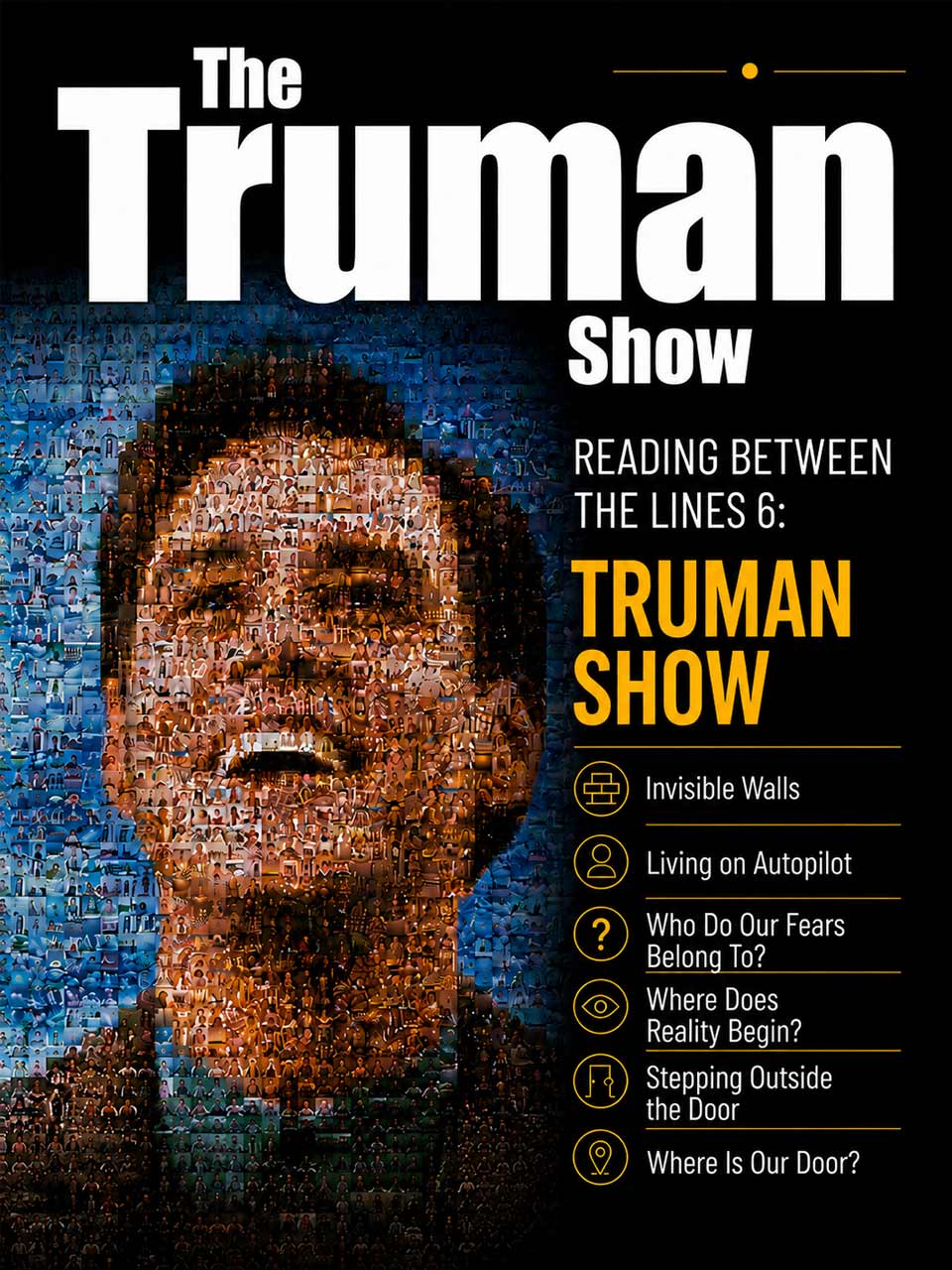
The Truman Show is one of those films — and this time, it became the focus of our sixth Between the Lines gathering.
A man who has lived inside a giant studio since birth. Everyone in his life playing a role. Every moment watched by millions.
When the film was released in 1998, the idea seemed strange, even dystopian. Yet over the years, our world has gradually turned into a stage of “voluntary Trumans” — people willingly sharing their lives while chasing views, followers and attention.
But at its heart, The Truman Show is a story of transformation.
Invisible Walls
Truman’s world has clear boundaries. He is surrounded by water. Escape seems impossible. His fears have been carefully designed, and the limits of his life have been decided by others.
Our walls may look different today.
Social media feeds, algorithms, advertising, news, consumption habits, definitions of success, beauty standards, career expectations…
Every day, we are exposed to hundreds of messages telling us what to want, how to look and how to live.
So, are we really making our own choices?
Or do we simply believe that we are?
Living on Autopilot
One of the most striking elements of the film is Truman’s routine.
The same greeting every morning.
The same people.
The same roads.
The same story.
We all have our own repeating patterns too.
Habits.
Beliefs we accept without questioning.
Patterns we assume will continue simply because “this is how things have always been.”
Like Truman’s awakening, awareness rarely begins with a dramatic revolution.
It often starts with a small sense of discomfort.
Something doesn’t quite fit.
Then comes a question.
And then another.
Whose Fears Are We Carrying?
Truman’s fear of the sea was deliberately created and taught to him as a way of keeping him under control.
Which raises another question: How many of our fears are truly ours, and how many have we inherited from others?
“You can’t do it.”
“You’ll fail.”
“You won’t be safe.”
“Don’t even try.”
Like the bridge Truman initially cannot cross, many of us have an invisible bridge standing between where we are and what we are curious to discover.
Until we cross it, we cannot know what lies beneath our curiosity — or what taking that next step might make possible.
Where Does Reality Begin?
The journey towards truth begins with curiosity.
Often, we recognise what feels true for us not through rational thought alone, but through a quieter voice within.
In a genuine friendship, in love, in an honest conversation or relationship, there is often a sense of knowing. Something feels real.
Sometimes it is the presence — or absence — of that feeling that sets us on our way.
Walking Through the Door
The door in The Truman Show is a powerful representation of the thresholds we encounter in our own lives.
Truman reaches what he thought was the sky, only to discover a wall. Eventually, despite everything, he finds the door and walks through it.
What is equally fascinating is the reaction of the audience. After forming what they believe to be an unbreakable bond with him, they celebrate his decision to leave.
His exit is both an ending and a beginning.
And it leaves us with new questions.
How real will Truman’s choices be in the world outside? Can his audience live without finding someone new to watch? And perhaps more importantly: how ready are the viewers to take action on the choices in their own lives?
Change does not come with guaranteed outcomes.
Freedom, however, may lie precisely in our willingness to take a step despite uncertainty.
Where Is Our Door?
If we are searching for what is real, perhaps the question becomes:
Which door are we standing in front of in our own story?
During our conversation, some of us spoke about setting boundaries with technology. Others talked about reconnecting with nature and with ourselves. And some reminded us of the importance of companionship — of not having to walk the path alone.
Perhaps the journey begins by first discovering the world we are already living in.
Only then can we begin looking for the door — and find the courage to turn the handle despite our fear.
Truth is not always comfortable.
But perhaps it is precisely in that uncomfortable space that transformation begins.