
From the Information Economy to the Attention Economy
How many times is your attention interrupted during the day? And how often are you able to truly focus?
Between messages, meeting invitations, colleagues arriving with questions and a constant stream of news and notifications, protecting our attention has become increasingly difficult. Today, one of the scarcest resources in leadership is not time, but attention.
The philosopher Epictetus captured this idea almost 2,000 years ago: “You become what you give your attention to.” The thought feels even more relevant today, when protecting our focus means navigating an unprecedented number of distractions.
Unlike in the past, access to information is now almost limitless. In a world overflowing with information, the real challenge is deciding where to direct our limited time, energy and attention.
We are no longer simply living in an information economy. We are living in an attention economy.
Where a Leader’s Attention Goes
Whether consciously or not, leaders influence what their teams pay attention to.
Very often, what captures the leader’s attention gradually becomes important to everyone else too. A leader who consistently focuses on customer experience makes the team more attentive to customer needs. A leader who invests attention in learning and innovation encourages curiosity and development. Equally, when a leader focuses almost exclusively on numbers and results, the team learns to direct its attention there too.
Where leaders place their attention therefore shapes more than their own performance. It influences how their teams work and, over time, the culture of the organisation.
Effective leadership is not about responding to everything that appears. It is about distinguishing what matters from what merely feels urgent — and directing attention with intention.
What Kind of Leader Are You: Busy or Effective?
If your days are filled with back-to-back meetings, calls, messages and conversations, you are probably busy.
But being busy is not the same as being effective.
Effective leadership requires clarity of intention, purpose and desired outcomes. When we know what truly matters, our priorities become clearer too.
An effective leader is not someone who responds to every call for attention, but someone who can protect their focus in service of what they are trying to achieve.
When Cognitive Load Becomes a Problem
Our brains do not have unlimited capacity. Every meeting, email, decision and interruption takes up a share of our mental resources.
Research published in 2024 reinforces what we increasingly experience in everyday working life: people are not particularly effective at carrying out multiple cognitively demanding tasks at the same time. What we call multitasking is often, in reality, task switching.
And every switch comes at a cognitive cost. Attention becomes fragmented, productivity declines and the quality of our decisions can suffer.
High-performing leaders do not only manage their time. They manage their attention.
Because when attention is fragmented, performance becomes fragmented too.
Leadership is not about being available to everything at every moment. It is also about being able to give your full attention to what matters most, when it matters most.
Keeping People in Focus
One area that deserves a leader’s consistent attention is people.
Sustainable results depend not only on strategy and execution, but also on the quality of relationships within a team.
People-centred leadership therefore requires leaders to:
- maintain emotional awareness and recognise the needs of their team members,
- notice the emotional climate beyond what is being explicitly said,
- use social intelligence to strengthen relationships and navigate relational challenges,
- listen deeply, appreciate contribution and support people’s development.
Attention, in this sense, is not simply about concentration. What — and whom — we choose to notice is itself an expression of leadership.
Creating Mental Space
Leadership is not always about doing more. Sometimes it is about creating enough mental space to see more clearly what deserves our attention.
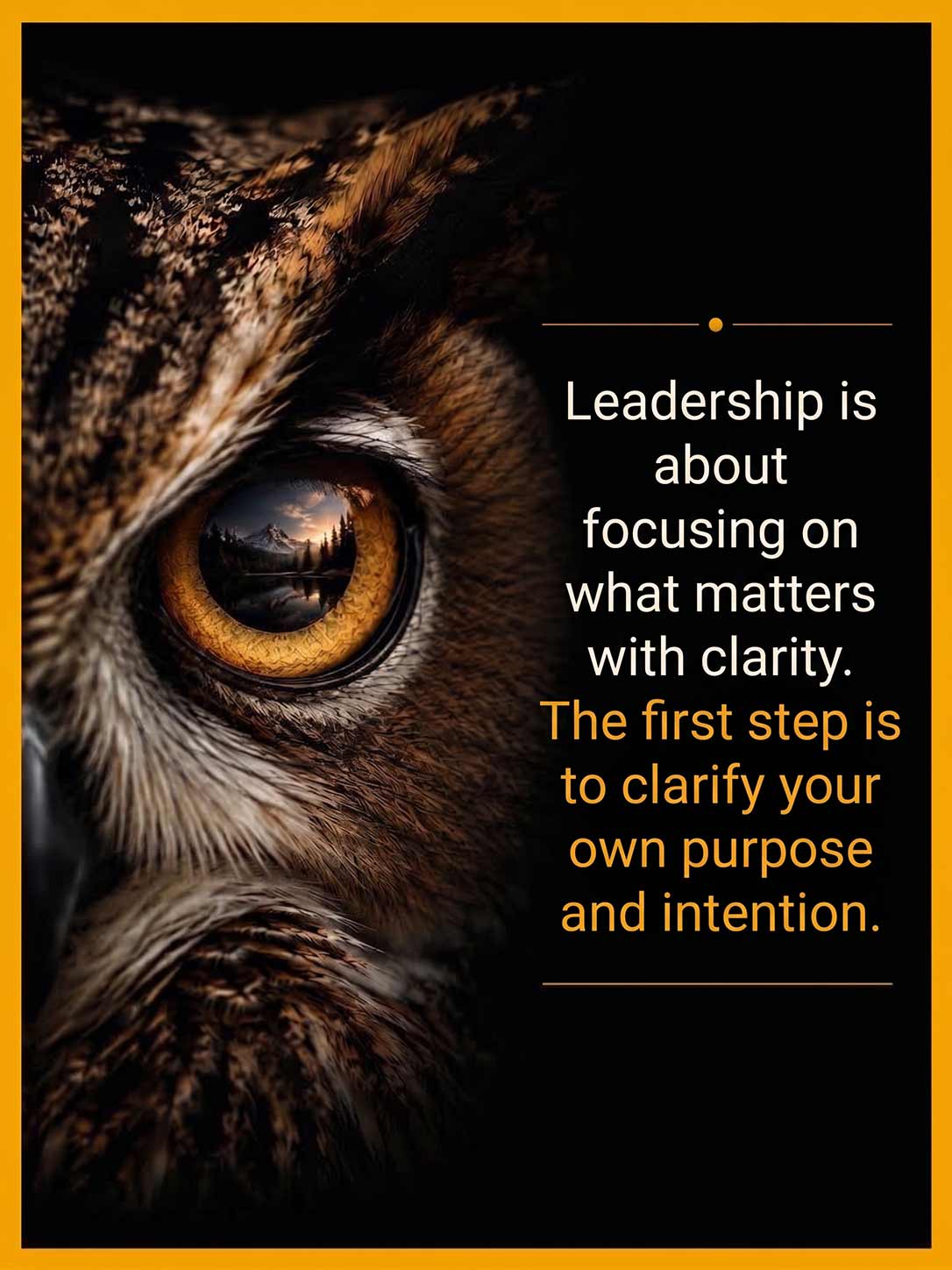
The starting point is clarity about our own purpose and intention.
Most of us want our work to create value, make a contribution and allow us to build meaningful relationships. Yet at the end of the day, what exhausts us is often not simply how much we have done. It is the feeling that we have not given enough time and attention to what truly mattered.
To protect our focus, it can be useful to pause regularly and ask:
- Are my priorities genuinely clear in relation to my purpose and vision?
- Do I create enough space to stop, think and reflect?
- Am I simply managing the relationships within my team, or am I really noticing what is happening between people?
- Are my everyday decisions aligned with my longer-term intentions?
Leadership is often associated with having the right answers. Yet perhaps there is a more fundamental question:
Where are you placing your attention?
Because what we pay attention to tends to grow. At the same time, what we repeatedly overlook also shapes the future.
And teams often become attentive to the very things their leaders consistently notice.
Peter Drucker wrote about time as a scarce resource and suggested that how we actually spend it reveals our real priorities.
Which leaves us with one final question:
How closely does your attention reflect what you say truly matters?