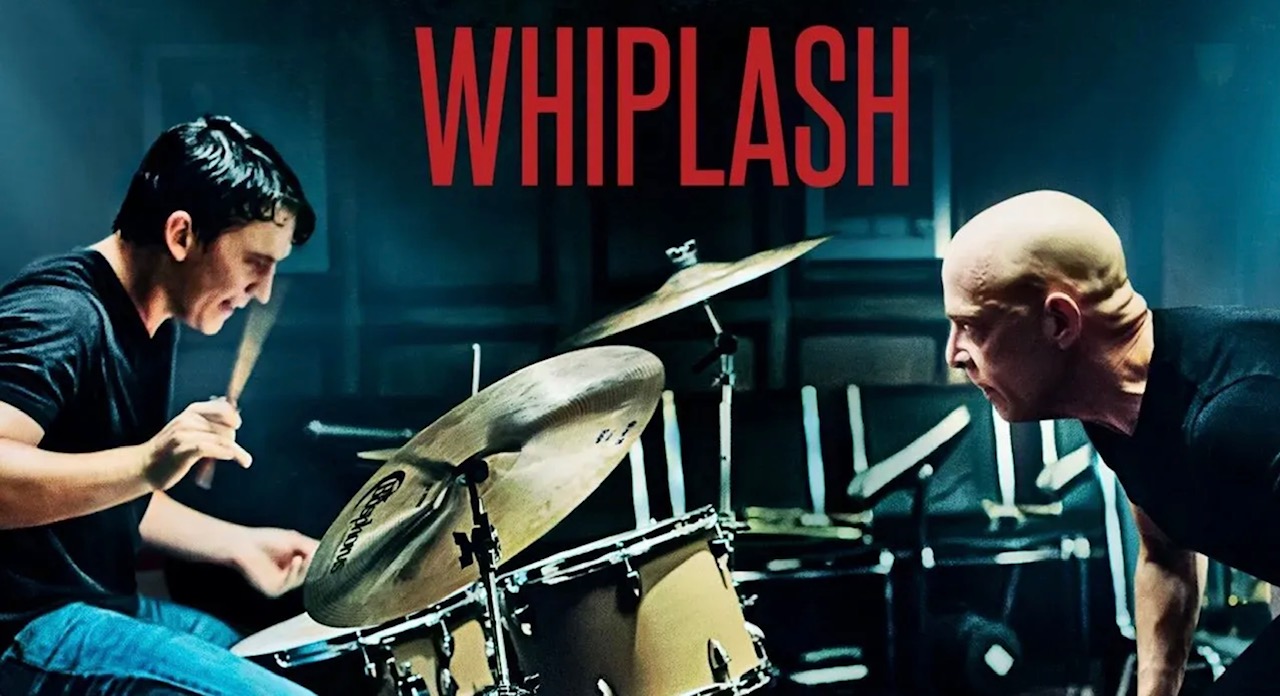
This month, at Between the Lines Gatherings, we explored themes of passion, ambition, perseverance, violence, potential, and boundaries through the film Whiplash.
Although classified as a drama, the film carries an intensity that rivals many psychological thrillers. The fact that its director created such a lasting and powerful work at the age of just twenty-nine makes it all the more remarkable.
As with every gathering, our conversation opened different doors for each of us.
For some, watching the film was challenging, an unsettling experience shaped by its relentless rhythm, overwhelming sound, and psychological violence.
For others, it was a compelling story that raised questions about the forces that awaken human potential.
Throughout the discussion, we kept returning to one central question:
How much pressure does it take to bring out the genius within a person?
Or perhaps potential only emerges when it is challenged, tested, and pushed beyond its limits.
Did Andrew possess passion, or obsession?
Was Fletcher a mentor, or a bully?
And when success comes at the expense of human dignity, can it still be called success?
Some of us found Fletcher’s cruelty impossible to justify.
After all, unlocking a person’s potential should not require humiliation, degradation, or abuse.
Others argued that if we choose to remain in a relationship, there is usually something within it that continues to draw us in—and talent may be one of those forces.
The Thin Line Between Passion and Ambition
One of the most meaningful stops in our conversation was the distinction between passion and ambition.
Passion is a force that nourishes us.
It gives us energy, purpose, and movement.
Perhaps it is passion that enables us to endure even under the most difficult conditions.
Another subtle distinction emerged between perseverance and ambition.
Perseverance offers a more balanced perspective.
Ambition, however, can become something darker when it drives a person to disregard their own well-being, relationships, physical limits, and emotional needs.
Andrew’s gradual withdrawal from his social life, his relationships, and even his own emotional world became one of the most striking examples of this transformation.
A desire for success intertwined with ambition can eventually become a pressure that focuses solely on the goal, silencing every other aspect of a person’s life.
In this sense, Whiplash is not merely a story about individual achievement.
It is also a reflection of the performance-driven culture of the modern world.
Power, Authority, and the Cost of Excellence
Through Fletcher’s character, we found ourselves exploring questions of authority and power.
His methods could easily be described as “harsh but effective.”
Yet for many of us, the film revealed how toxic authority can become normalized and how it can be legitimized through narratives of success.
For some participants, Fletcher was not simply an individual.
He represented the system itself.
And remaining within that system often seemed possible only through adaptation and compliance.
The Final Performance
The film’s final scene opened one of the richest discussions of the evening.
For some, it was the moment Andrew finally took control and declared his own existence.
For others, it represented the system’s ultimate victory—a moment in which the student became part of the very structure that had broken him.
Some saw it as the point where master and apprentice finally met in the ideal place they had both been seeking.
Others experienced it as a comma rather than a conclusion, a transition into a new chapter of the story.
Every glance, silence, expression, and musical shift within that extended final sequence seemed worthy of its own conversation.
The scene was not simply a concert performance.
It was the culmination of an entire relationship, containing every dynamic of power, approval, resistance, and challenge.
Was Andrew truly becoming free?
Or was he becoming even more deeply attached to Fletcher the moment he finally earned his approval?
Questions That Remained
Amid all these reflections, deeper questions about ourselves and our lives began to emerge:
Can talent flourish through compassion and understanding rather than relentless pressure?
How possible is it to pursue passion without leaving yourself wounded along the way?
When jealousy and limitless ambition invite us toward a darker path, what prevents us from crossing that line?
And many more questions could be added to the list.
That is where Whiplash finds its power.
It unsettles us.
It forces us to ask difficult questions.
It invites us to recognize the Fletchers and Andrews within our own lives.
Each of us is motivated differently.
Each of us has different levels of resilience, different boundaries, and a different definition of success.
Some are inspired by encouragement.
Others are energized by challenge and by pushing beyond their limits.
But regardless of the path we choose, perhaps the most important task is learning how to move forward without losing our inner voice, our boundaries, or our sense of worth.